
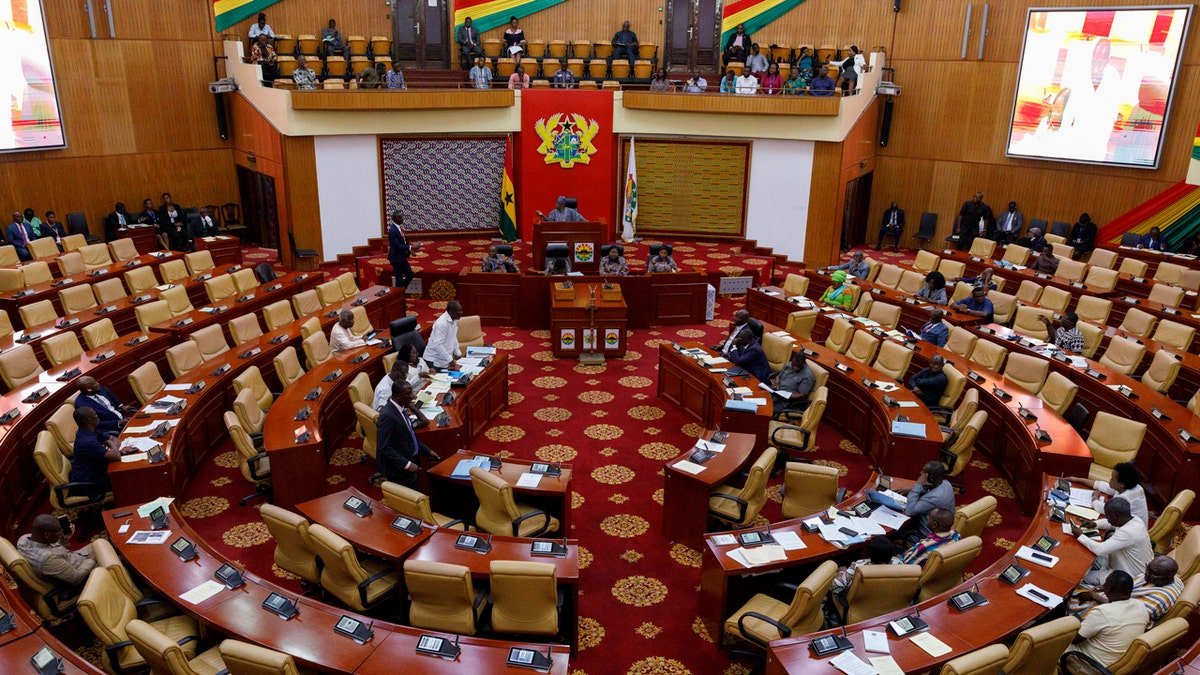
In this publication, I engage directly with the Ghanaian political landscape, scrutinizing the conduct of politicians—predominantly men—and their female subordinates, whose approach to governance is defined by a penchant for extravagance and profligacy. Frankly stated, the contemporary Ghanaian politician exhibits a conspicuous deficit of authentic leadership, a void masked by ostentatious displays and amplified by a cadre of message-entranced adherents. These followers, oblivious to their own subjection, absorb vacuous rhetoric meticulously tailored in the language of colonial legacy.
The contemporary Ghanaian politician stands in stark contrast to the leaders of old—especially visionaries like Kwame Nkrumah, whose enduring legacy is etched in both history and national memory. In their place, we find a cohort of TikToker politicians, eager to impress yet content to recite scripts from their phones in public and in parliament, mistaking spectacle for substance. Many among them lack even the intellectual stamina to sustain an idea beyond the fleeting hour, let alone marshal the requirements necessary for genuine leadership. Terms such as “development” and platitudes like “we have measures in the pipeline” are invoked with monotonous regularity—dreams peddled as policy, yet perennially unfulfilled. Can one lay the blame solely at their feet, particularly in a nation where vacuous words are often prized by followers conditioned to mistake rhetoric for reason?
As monetized politics entrenches itself as the chief determinant of presidential and parliamentary elections and cabinet appointments—positions increasingly reserved for those who can outspend or out-contribute their rivals—it is untenable for us to continue burying our heads in the proverbial sand. We are, if reluctantly, complicit witnesses to a political order that rewards individuals whose ambition rarely transcends the hollow honorific of ‘Honourable,’ regardless of how dishonourable their conduct may be. Consider, for instance, the case of Ohene Kwame Frimpong, arrested in the Netherlands in 2026 on charges of online fraud and money laundering—a stark testament to the moral decay festering beneath the veneer of public service.
Even more disturbing is the unseemly alacrity with which the National Democratic government and state apparatus rushed to provide the embattled parliamentarian with legal and consular support—a display akin to a mourner wailing louder than the bereaved. I cannot recall a time when the state, under the Fourth Republic, extended similar legal assistance to the countless indigent citizens languishing in prison for crimes they did not commit. In Orwellian Ghana, the disturbing reality persists: some citizens, no matter how duplicitous or unscrupulous their actions, are accorded privileges and protections denied to those who serve the nation with integrity. This is not merely a crisis of policy, but a profound indictment of the moral architecture underpinning our democracy.
The Ghanaian politician—from the president, to members of parliament, to the coddled ranks of favoured appointees—has been reduced to nothing more than a leech, a mooch, a parasite fattening itself on the lifeblood of the nation. These men and women gorge themselves at the national trough, feasting on an obscene array of perks: free housing, unlimited petrol, complimentary hydroelectricity, clothing and entertainment allowances, a pair of official vehicles, endless foreign junkets—the list of entitlements is so grotesquely long that even King Charles, perched atop the remnants of empire, would envy the earnings of his former colonial subjects. This is not governance; it is sanctioned gluttony masquerading as public service, a shameless carnival of self-enrichment presided over by those who have long since abandoned any pretense of duty or honour.
In Ghana, a disconcerting culture of clientelism has been meticulously engineered by politicians—many of whom, despite lacking intellectual distinction, have mastered the art of electoral survival. These officeholders have accumulated considerable wealth, not to foster national development, but to dispense selective largesse among a coterie of supporters. This transactional relationship, in which resources are divvied up to a largely apathetic electorate, perpetuates a cycle of dependency and undermines any meaningful understanding of the nation’s political realities. It is an exploitation skillfully disguised as benevolence, eroding the foundations of participatory democracy and entrenching mediocrity at the heart of governance.
It has become a predictable spectacle in Ghanaian politics: politicians with tainted hands, fearing prosecution, seek sanctuary by purchasing chieftaincy titles, religious offices, or church elderships—or by fleeing national borders, only to return when it is politically expedient. Upon their return, government lawyers are quick to invoke nolle prosequi in courts dominated by government-appointed judges, even when evidence incontrovertibly demonstrates their culpability in siphoning state resources for personal gain. The release of such individuals—especially politicians—charged with criminal offences at the behest of the Attorney General or state prosecutors is, sadly, no longer news to the discerning observer.
In a polity where justice and truth are alien, if not dead, concepts, and where favouritism has fully supplanted merit, the judiciary has become a stage for the ambitions of judges who, despite questionable records, are more preoccupied with ascending to the Appeal Court or Supreme Court than upholding the law. In such an environment, justice is neither expected nor delivered; what prevails are political verdicts, engineered and crafted by patrons in power as a currency for career advancement, security, and perks. This is not the rule of law, but a calculated subversion of justice that corrodes the very foundations of our democracy.
In the final analysis, the Ghanaian political class—and the citizenry who so readily enable them—have become a peculiar study in collective regression. Shackled by intellectual inertia and adept at the art of deception, they have succeeded in reversing the nation’s fortunes, even as neighbours like Burkina Faso, under Ibrahim Traoré, surge ahead. Obsessed with conspicuous consumption and extravagance, and cheered on by a constituency all too eager to justify their excesses, Ghana—once the beacon and pride of Africa—now writhes in self-inflicted distress. For those who care to see, the poverty that blights the land is not a product of fate, but a calculated artifact of greed, misallocated priorities, the appointment of the unfit, and an insatiable appetite for theft, all underwritten by the certainty of exoneration from a complicit government and its chorus of partisans. Until there is a fundamental reorientation of mind and conduct—a feat beyond the capacity of the current leadership—the vision of Nkrumah’s Ghana will continue its agonizing descent, inching ever closer to the ignoble fate of a failed state draped in the hollow trappings of democracy.
