
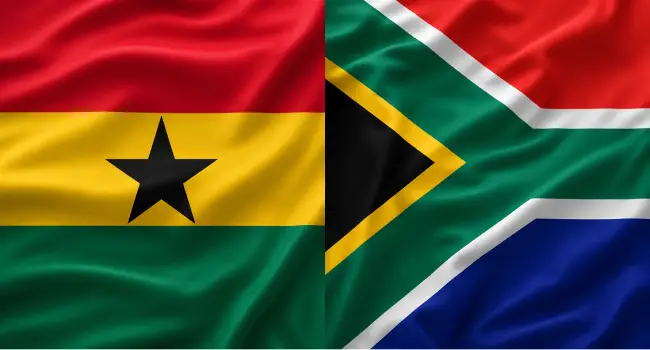
In this article, I interrogate the enduring bond of siblinghood between Ghana and South Africa—a relationship far deeper than the sensationalist narratives advanced by “March and March” protestors and amplified by Western media would suggest (Adogamhe, 2008; Mbeki, 2012). While calls for the expulsion of Ghanaians and other Africans have captured headlines, such divisive rhetoric ignores the profound historical and political connections forged through shared struggles against colonial domination and apartheid (Akyeampong & Gates, 2012).
Ghana’s pivotal role under Kwame Nkrumah in supporting the Pan-Africanist Congress, led by Robert Mangaliso Sobukwe, remains a cornerstone of Pan-African solidarity (Adi, 2012). Both Nkrumah and Sobukwe believed fiercely in African self-governance, resisting both external colonial impositions and internal attempts to dilute the Pan-African flame (Zeleza, 2014). Despite contemporary pressures from foreign interests and opportunistic political actors seeking to sow discord, the historical ties and shared destinies of Ghana and South Africa must be recognized, preserved, and celebrated. Only through critical reflection and mutual engagement can the Pan-African spirit endure and flourish.
Building on his early political career, Nkrumah’s tenure as general secretary of the United Gold Coast Convention (UGCC) was marked by growing frustration with the complacency and elitism of his peers—many of whom were content with the British government’s empty promises of gradual reform (Adi, 2012; Biney, 2011). Nkrumah recognized that these promises were calculated to placate the Gold Coast’s elite and indefinitely postpone true independence. Rejecting this conservative approach, he championed “Positive Action” and “Freedom Now” as more than slogans—they were urgent calls for ideological confrontation and mass mobilization, rooted in the conviction that genuine national and continental freedom could only be achieved through direct, assertive action (Nkrumah, 1961; Zeleza, 2014). For Nkrumah, independence was inseparable from the restoration of Black dignity and the broader liberation of Africa from colonial rule.
Transitioning to his vision for continental liberation, Nkrumah forcefully argued that imprisonment for anti-colonial activism was preferable to a life of submission and servitude under colonial rule (Biney, 2011). For Nkrumah, Ghana’s struggle for independence was inseparable from the broader African fight against colonialism—a conviction immortalized in his historic declaration: “The independence of Ghana is meaningless unless it is linked-up with the total liberation of the African Continent” (Nkrumah, 1961, p. 93). He acknowledged the immense challenges ahead but insisted that a transformed African mindset would enable the continent to reclaim agency and dignity: “a new Africa is ready to fight his own battles and show that, after all, the Black man is capable of managing his own affairs.” This radical message reverberated throughout the Pan-Africanist Congress under Sobukwe’s leadership, galvanizing a generation to pursue uncompromising continental emancipation (Adi, 2012; Zeleza, 2014).
Shifting to the pivotal moment of the All-African People’s Conference in Accra on December 8, 1958, Nkrumah—then Prime Minister of newly independent Ghana—delivered a powerful indictment of colonialism and an impassioned call for African self-representation (Adi, 2012; Biney, 2011). He leveraged the gathering of freedom fighters, nationalist organizations, and trade unionists to assert that Africans must speak for Africa, demanding unity and collective action for continental freedom and independence. Nkrumah’s address explicitly spotlighted the plight of Black South Africans and the peoples of neighbouring dependent territories, making the struggle against apartheid and settler colonialism a continental mandate (Zeleza, 2014; Mazrui, 2003).
Fully cognizant of the risks Ghana faced in defying imperial interests, Nkrumah declared Ghana’s unyielding commitment to supporting oppressed peoples, vowing to resist imperialism and all its variants—including “racialism,” his pointed reference to White settler domination and anti-Black violence (Biney, 2011; Adi, 2012). He challenged African leaders to remain courageously committed to the cause of liberation, undeterred by the inevitable hardships ahead.
Continuing his uncompromising stance, Nkrumah framed the 1958 All-African People’s Conference as the beginning of a decisive new chapter in Africa’s anti-colonial struggle (Adi, 2012; Biney, 2011). He rallied liberation movements from across the continent and dependent territories to adopt bolder, even armed, strategies to “wipe out imperialism and colonialism and erect in their places a union of free [and] independent African States” (Nkrumah, 1961, p. 132). Nkrumah demanded that Africans seize opportunities to strike against their oppressors at moments of weakness, unapologetically pursuing the imperative to shatter the grip of White domination. He further pledged to share Ghana’s revolutionary experience, fully aware of the risks—a commitment that ultimately cost him his presidency in the 1966 coup but never shook his resolve (Biney, 2011; Mazrui, 2003). Nkrumah’s militant vision and sacrifice remain a clarion call for continental self-determination.
Expanding on his fierce advocacy for African self-determination, Nkrumah’s address to the United Nations on October 5, 1961, was a scathing indictment of Western imperialism and UN inaction, particularly in the wake of Patrice Lumumba’s assassination in the Congo (Nkrumah, 1961; Biney, 2011). Nkrumah condemned the West’s grudging concessions of independence and declared that only African unity could provide authentic solutions to the continent’s crises. For Nkrumah, solidarity was not optional—Africa had a duty to extend tangible support to territories still suffering under colonial and white minority rule (Adi, 2012).
Shifting focus to continental affairs, Nkrumah’s landmark “We Must Unite or Perish” speech at the Organization of African Unity in Addis Ababa on May 25, 1963, challenged African leaders to transcend empty rhetoric and forge a united front against colonial domination (Biney, 2011; Mazrui, 2003). He demanded that independent African states not only commit to charter ideals but actively assist liberation movements. Nkrumah’s vision of a common African destiny was foundational in Ghana’s support for the anti-apartheid struggle in South Africa and beyond
Expanding on this ideological legacy, striking parallels emerge between Nkrumah and Sobukwe in their uncompromising rejection of colonial structures and their unwavering belief in the African personality, identity, capability, and humanity (Adi, 2012; Biney, 2011). Both leaders positioned the reclamation of African agency as central to the continent’s liberation, insisting that Africans must define their destiny on their own terms, free from the vestiges of colonial subjugation (Mangcu, 2012; Zeleza, 2014).
Sobukwe’s formative years and emergence as a formidable political activist began at Fort Hare University, where he joined the African National Congress Youth League and became President of the Student Representative Council in 1948—the year South Africa officially adopted apartheid under Prime Minister D. F. Malan (Lodge, 1983; Maaba, 2001; Ndlovu-Gatsheni, 2013). Sobukwe quickly recognized the corrosive impact of racist legislation on Black students and the broader Black population (Posel, 2001; Worden, 2012). The veneer of dignity afforded by campus life could not mask the brutal realities of colonial violence, humiliation, and even death at the hands of the state (Mangcu, 2012). Sobukwe viewed colonial education at Fort Hare as a tool designed to co-opt Black students into serving the interests of the apartheid regime, turning them into willing adjuncts against their own people (Pityana et al., 1991). Rejecting this insidious agenda, Sobukwe chose the revolutionary path—confronting the regime and challenging the myriad forms of institutionalized racism with unwavering resolve (Posel, 2001; Worden, 2012; Zeleza, 2014).
Further sharpening his critique, Sobukwe was not only a student of Black history and experience but also rigorously analyzed the mechanics of apartheid through his studies in Native Administration, exposing the racial engineering behind the governance of Black South Africans (Lebakeng, 2018; Posel, 2001; Worden, 2012). This academic grounding fueled his commitment to a militant, Pan-Africanist anti-apartheid campaign that centred the plight of all colonized peoples across the continent (Lodge, 1983; Ndlovu-Gatsheni, 2013). Like Nkrumah, Sobukwe believed that South Africa’s liberation struggle was fundamentally intertwined with Africa’s collective fight against colonial domination; oppression anywhere in Africa was oppression everywhere (Lebakeng, 2018; Lodge, 1983; Ndlovu-Gatsheni, 2013).
Sobukwe fiercely rejected the artificial borders and ethnic divisions imposed by colonial administrators, insisting that African fraternity was rooted in a shared destiny—not in identities or cultures fractured for colonial convenience. He condemned Black local authorities—Native Representative Councils and Native Advisory Boards—who aligned themselves with colonial power for personal gain, oblivious to the damage wrought upon the Black collective (Lebakeng, 2018).
Intensifying his divergence from the mainstream, Sobukwe’s move to Mofolo (now part of Soweto) and his lecturer post at the University of Witwatersrand marked a new phase of militant intellectual activism (Lebakeng, 2018). He leveraged Beware, Pan-Africanist social commentaries as an uncompromising platform to denounce the ANC’s collaboration with the White establishment, arguing that such alliances fractured Black unity and ultimately prolonged the stranglehold of the apartheid regime (Lodge, 1983; Ndlovu-Gatsheni, 2013).
Sobukwe, a staunch Pan-Africanist, insisted that African liberation required a wholesale rejection of White supremacy and the inferiority myth imposed on Africans—a vision resonant with Nkrumah’s demand for continental solidarity against colonial oppressors (Lodge, 1983; Ndlovu-Gatsheni, 2013). Unlike the ANC’s incrementalist approach, which Sobukwe saw as timid and complicit, he called for immediate, continent-wide emancipation and condemned the concept of multiracialism in a Black-majority country as an affront to democratic principles (Lodge, 1983).
In 1959, Sobukwe’s frustration with the ANC’s caution and acceptance of the Freedom Charter—a document he deemed a betrayal of Black self-determination—led him to found the Pan-Africanist Congress. For Sobukwe, the Charter’s rhetoric that “South Africa belongs to all who live in it” (Maaba, 2001, p. 421) was a capitulation, diluting Black suffering and deferring genuine liberation in favour of political expediency (Lodge, 1983; Ndlovu-Gatsheni, 2013).
Expanding on this ideological lineage, Sobukwe distinguished himself through an uncompromising commitment to immediacy in the struggle for Black liberation, mirroring Nkrumah’s radical call for “Independence Now” and “Positive Action”—methods that included mass mobilizations, sit-ins, and boycotts against colonial and White minority rule (Adi, 2012; Biney, 2011; Nkrumah, 1961). Sobukwe categorically rejected the gradualism favoured by reformist elites, viewing any attempt to partition South Africa into Bantustans or to acquiesce to ethnic and cultural compartmentalization as a betrayal of the anti-colonial cause and a perpetuation of apartheid’s logic (Lodge, 1983; Ndlovu-Gatsheni, 2013; Posel, 2001).
Sobukwe advanced a Pan-African vision, insisting that the struggle in South Africa was inseparable from broader continental liberation movements. He warned that deferring freedom or accepting fragmented sovereignty would only embolden oppressors and prolong Black subjugation (Mangcu, 2012; Zeleza, 2014). This conviction was forcefully echoed in Nkrumah’s declaration on March 6, 1957: “Our independence is meaningless unless it is linked to the total liberation of Africa” (Nkrumah, 1961, p. 93). Both leaders insisted that Africa’s strength lies in unity—transcending artificial geographic, ethnic, and cultural boundaries imposed by colonial powers. For Sobukwe, embracing African unity was not mere rhetoric but a strategic imperative for dismantling the structures of White supremacy and achieving genuine emancipation for all Black people (Adi, 2012; Lebakeng, 2018). Critically, Sobukwe’s legacy as an aggressive proponent of immediate, collective action continues to inspire contemporary movements that resist not only racial oppression but also the political inertia and factionalism that still threaten African progress (Mangcu, 2012; Zeleza, 2014; Adogamhe, 2008). His example serves as a powerful reminder that liberation is achieved not through compromise or gradual reform, but through courageous, united resistance.
Escalating the anti-apartheid struggle to its most defiant phase, the Pan-Africanist Congress (PAC) under Sobukwe’s uncompromising leadership orchestrated a national protest against South Africa’s Pass Laws on March 21, 1960—a campaign that culminated in the Sharpeville massacre, where police killed 69 unarmed protesters (Worden, 2012; South African History Online, n.d.; The New York Times, 1960). Sobukwe, demonstrating unparalleled resolve, led his supporters to surrender their passbooks at the Soweto police station, an act of direct confrontation with state power (Lebakeng, 2018).
Sobukwe was arrested, charged with incitement, and sentenced to three years’ imprisonment—a sentence he accepted without appeal or legal counsel, underscoring his commitment to the cause (Posel, 2001; Lebakeng, 2018). The apartheid regime, recognizing his influence, amended the General Law Amendment Act in 1963 to include the notorious “Sobukwe Clause,” allowing indefinite detention of political prisoners—legislation crafted explicitly to neutralize Sobukwe by extending his imprisonment beyond his sentence (Republic of South Africa, 1963; Posel, 2001; Worden, 2012).
Under the Sobukwe Clause, he endured an additional six years in solitary confinement on Robben Island, marking him as one of the apartheid state’s most feared and isolated political prisoners (South African Government, 1963; Truth and Reconciliation Commission, 1997; Lebakeng, 2018). Upon release in 1969, Sobukwe was exiled to Kimberley, where state surveillance and isolation continued until his death from lung complications on February 27, 1978 (SouthAfrica-Info, 2026). He is buried in Graaff Reinet, his legacy immortalized as a relentless adversary of White supremacy and a martyr of African liberation (Lebakeng, 2018; Mangcu, 2012).
Moving forward, I sharply delineate Ghana’s unwavering commitment to the liberation of Southern African nations, with a particular focus on South Africa. This analysis challenges the revisionist narrative that Ghana and other independent African states abandoned Black South Africans during apartheid’s darkest hours. In fact, Ghana provided critical diplomatic, financial, and moral support to anti-apartheid movements, often at great risk and sacrifice (Adi, 2012; Biney, 2011; Zeleza, 2014).
Despite limited resources, Ghana’s solidarity was uncompromising. Nkrumah’s government extended the “widow’s mite,” sending funds, logistics, and sanctuary to exiled activists, while enduring relentless pressure and reprisals from neocolonial powers determined to punish any state that threatened the status quo (Mazrui, 2003; Rooney, 2007). Western intelligence agencies and their regional allies never forgave Nkrumah for his bold advocacy of Black emancipation and Pan-African unity; his overthrow in 1966 was, in part, a direct consequence of his anti-imperialist activism (Biney, 2011; Rooney, 2007). Ghana’s legacy is not one of indifference, but of principled resistance—proof that, despite artificial colonial borders, the struggle for African freedom is a shared, continental cause (Zeleza, 2014; Adi, 2012).
Shifting focus to concrete support, Nkrumah’s government, despite the vast distance from South Africa, directly funded and established military training camps in Ghana for Southern African liberation fighters. The goal was clear: to equip guerrillas to overthrow apartheid and dismantle regimes that trampled Black freedom and justice (Grilli, 2018; Adi, 2012). The Bureau of African Affairs (BAA), under the initial leadership of George Padmore and later David Bosumtwi-Sam, operated as a pan-African intelligence and logistics network, predating and inspiring the Organization of African Unity (Grilli, 2018; Rooney, 2007). Nkrumah was no pacifist. He recognized that the apartheid regime would not yield to diplomacy alone. Armed struggle, supported by Ghana’s limited but resolute resources, was a necessary and legitimate path to liberation (Biney, 2011; Grilli, 2018). He advocated a dual strategy—combining positive action with military resistance—to break the back of South African apartheid and ignite continental emancipation.
Turning to tactical support, Nkrumah’s commitment went far beyond rhetoric. In May 1959, he transformed the African Affairs Centre (AAC) in Accra into a hostel and staging ground for African freedom fighters—an operational hub for those en route to military training camps in Ghana (Grilli, 2018). After the Sharpeville Massacre in March 1960, Ghana became a safe haven for South African refugees, and Accra hosted the South African United Front (SAUF), a coalition of the PAC and ANC, personally funded by Nkrumah until its collapse in 1962. At the Mankrong training camp in the Eastern Region, the first course began on 3 December 1961 and ended on 23 June 1962, consisting of eight weeks of commando training and ten weeks of weapons and explosives training (Grilli, 2018, p. 67). This direct sponsorship underscores Nkrumah’s relentless drive for Black South African liberation and continental unity (Grilli, 2018; Adi, 2012).
State archival evidence confirms the scope of this intervention. Between March and September 1960, Ghana trained dozens of South African activists in martial arts and sabotage; in August alone, 22 PAC members received military training, and another 30 “Bantu from Johannesburg” followed in December (Grilli, 2018, pp. 63–64). While these numbers may seem modest, for the apartheid regime, even small cadres of trained militants represented a grave national security threat—one warranting harsh repression. Nkrumah’s Ghana, undeterred by risk, stood at the forefront of African resistance, leveraging limited resources to disrupt the machinery of White supremacy and embolden the liberation struggle (Rooney, 2007; Zeleza, 2014).
In 1961, Nkrumah committed the External Service of the Ghana Broadcasting System, enabling Radio Ghana’s broadcasts to reach almost the entire continent. Specific programmes on African liberation were delegated to the offices of parties represented in Accra, such as the PAC. This direct sponsorship underscores Nkrumah’s relentless drive for Black South African liberation and continental unity (Grilli, 2018; Adi, 2012).
Nkrumah weaponized culture—arts, radio, poetry, debate, and music—as a forceful tool for political mobilization and memorialization of apartheid’s victims and heroes. The Voice of Africa, a state-funded media platform, empowered PAC leaders like Peter Raboroko to provide literary and strategic direction, broadcasting revolutionary messages and essays to a continent-wide audience (Grilli, 2020). Radio Ghana, through the “Freedom Fighters” program, gave voice to liberation organizations aligned with Nkrumah, amplifying the South African struggle and forging pan-African solidarity. These broadcasts were more than propaganda; they were calls to action. Songs like Miriam Makeba’s “Khawuleza,” which exposed township terror, and “Beware, Verwoerd! (Ndodemnyama),” a direct warning to apartheid’s architects, became anthems of resistance. “Mombela/Umbombela,” the train song, symbolized the journey and hardship of Black South Africans under White rule. Through these cultural interventions, Nkrumah’s Ghana not only challenged apartheid’s narrative but also galvanized African unity and resistance (Allen, 2004; Coplan, 2008).
In Accra, the naming of Sobukwe Road and Steve Biko Road after Robert Mangaliso Sobukwe and Steve Biko—iconic leaders in South Africa’s anti-apartheid struggle—constitutes far more than symbolic commemoration. These streets embody the enduring, substantive alliance between Ghana and South Africa, forged in a shared resistance to White settler colonialism, imperialism, and racism (Adi, 2012; Grilli, 2018). In the African traditional context, such gestures represent kinship—two proverbial siblings united in a common cause, regardless of geographical distance or political differences (Mazrui, 2003).
These road names are living testaments to the Pan-African spirit championed by Nkrumah and the profound solidarity that transcends death, adversity, and shifting political landscapes. Sobukwe and Biko Roads are daily reminders that the Ghana-South Africa bond is not only historical but also foundational to Africa’s ongoing fight for justice and self-determination (Rooney, 2007; Zeleza, 2014).
In conclusion, the historical alliance between Ghana and South Africa is not merely a relic of the past but a living testament to the power of Pan-African solidarity. Nkrumah’s Ghana risked everything—from economic reprisal to geopolitical isolation—to support Black South Africa’s liberation, setting a standard of sacrifice and commitment that modern African states too often neglect. Today, as reactionary movements and xenophobic rhetoric threaten to fracture this bond, it is imperative that both nations reject division and reaffirm their collective destiny. True siblings do not allow temporary grievances or external pressures to destroy hard-won unity. Instead, Ghana and South Africa must engage in honest, closed-door diplomacy, recognizing that principled disagreement is a sign of respect, not enmity. Let their shared history serve as a rallying cry for Africa’s renaissance—a continent united not by convenience but by courage, commitment, and love for freedom.
References
Adi, H. (2012). Pan-Africanism and Communism: The Communist International, Africa and the Diaspora, 1919–1939. Africa World Press.
Adogamhe, P. G. (2008). Pan-Africanism Revisited: Vision and Reality of African Unity and Development. African Review of Integration, 2(2), 1-34.
Akyeampong, E. K., & Gates, H. L. Jr. (2012). Dictionary of African Biography. Oxford University Press.
Allen, L. (2004). Kwela’s White Roots: Early Apartheid and the Evolution of Black South African Music. Popular Music, 23(3), 331-353.
Biney, A. (2011). The Political and Social Thought of Kwame Nkrumah. Palgrave Macmillan.
Grilli, M. (2020). Ghana, Nkrumah and the Liberation of Southern Africa. Journal of Southern African Studies, 46(1), 1-19.
Coplan, D. B. (2008). In Township Tonight!: Three Centuries of South African Black City Music and Theatre (2nd ed.). University of Chicago Press.
Grilli, M. (2018). Nkrumah, the United States and the Pan-African Struggle for Southern Africa. Springer.
Lebakeng, J. T. (2018). Robert Mangaliso Sobukwe: Decolonial Pan-Africanism and the Struggle for Liberation in South Africa. African Identities, 16(1), 11-27.
Lodge, T. (1983). Black Politics in South Africa since 1945. Longman.
Maaba, B. B. (2001). The PAC’s War against Apartheid: Interview with Robert Sobukwe. African Affairs, 100(401), 419-424.
Mangcu, X. (2012). Biko: A Biography. Tafelberg.
Mazrui, A. A. (2003). Nkrumah’s Legacy and Africa’s Triple Heritage: Between Globalization and Counter Terrorism. Africa Development, 28(3/4), 27-46.
Mbeki, T. (2012). Advancing the African Agenda: A Collection of Speeches. Pan Macmillan.
Ndlovu-Gatsheni, S. J. (2013). Coloniality of Power in Postcolonial Africa: Myths of Decolonization. CODESRIA.
Nkrumah, K. (1961). I Speak of Freedom: A Statement of African Ideology. Heinemann.
Pityana, B., Ramphele, M., Mpumlwana, M., & Wilson, L. (1991). Bounds of Possibility: The Legacy of Steve Biko and Black Consciousness. Zed Books.
Posel, D. (2001). Race as common sense: Racial classification in twentieth-century South Africa. African Studies Review, 44(2), 87–113.
Republic of South Africa. (1963). General Law Amendment Act No. 37 of 1963.
Rooney, D. (2007). Kwame Nkrumah: Vision and Tragedy. Sub-Saharan Publishers.
SouthAfrica-Info. (2026). Robert Sobukwe. Retrieved from https://www.southafrica-info.com
South African Government. (1963). General Law Amendment Act (Sobukwe Clause).
South African History Online. (n.d.). Sharpeville Massacre, 21 March 1960. Retrieved from https://www.sahistory.org.za
The New York Times. (1960, March 22). 69 Die as Police Fire on Crowd; South Africa Imposes Curfew.
Truth and Reconciliation Commission. (1997, May 12). Human Rights Violations Submission Questions and Answers. Case: EC0155/97ALB – King William’s Town Day 1.
Worden, N. (2012). The Making of Modern South Africa: Conquest, Apartheid, Democracy (5th ed.). Wiley-Blackwell.
Zeleza, P. T. (2014). The Roots of African Conflicts: The Causes and Costs. Ohio University Press.
