
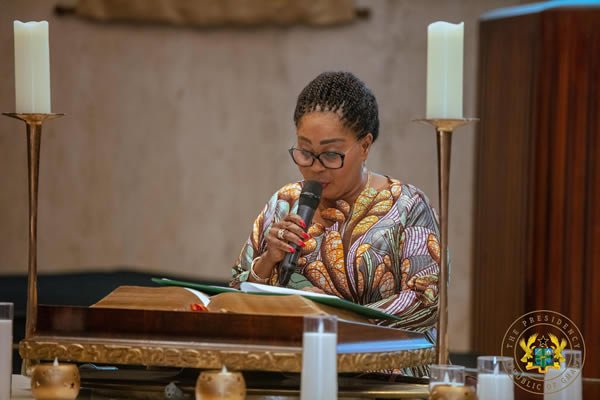
In her incisive article, “The First Lady’s job is to serve the people, not to pass an English examination” (GhanaWeb, 2026), Victoria Hammah rightly asserts that Lordina Mahama’s primary duty is national service—not linguistic prowess. This exposes a toxic national obsession: equating fluency in colonial languages with brilliance and competence. I argue that this fetish for English fluency, while disparaging mastery of indigenous languages, is a lingering symptom of (neo)colonialism—one that perpetuates the fallacy that intelligence is measured by proficiency in the colonizer’s tongue (Bamgbose, 2011; Prah, 2018). Such a standard not only undermines local identity but also continues the colonial project of intellectual subjugation.
In contemporary Ghana, an incurable linguistic insecurity grips the elite—politicians, policymakers, and even ordinary citizens—who contort themselves to croak in English, often butchering syntax and diction in a misguided pursuit of colonial approval (Prah, 2018; Bamgbose, 2011). This obsession reached new comedic heights when Stephen Amoah (“Sticka”), MP for Nhyiaeso, boasted that his European education granted him “phonetics” prowess, despite his pronounced accent (GhanaWeb, 2023). Such episodes, whether intended as humour or not, lay bare the deep-seated inferiority complex that plagues Ghana’s elite. The compulsion to showcase English proficiency—no matter how fractured—reveals a nation still shackled by colonial linguistic standards, where broken English is performed to a mesmerized but ultimately subjugated audience.
Building on Nkrumah’s legacy, it is clear that accent or limitations in speaking a colonial language are not intellectual deficits. Nkrumah insisted that Black intellectual freedom and sovereignty are not measured by colonial fluency but by the ability to connect with and mobilize one’s people in their own languages—languages that carry the collective spirit, values, and responsibilities of the community (Nkrumah, 1961; Prah, 2018).
In a country grappling with poverty, disease, escalating living costs, and rising teenage pregnancy, the insistence that Lordina Mahama—or any Ghanaian leader—must address the nation in the Queen’s English is both misplaced and elitist (Bamgbose, 2011; Ansre, 1979). True leadership demands engagement in local languages, fostering genuine dialogue with those most affected by national crises (Prah, 2018; Bamgbose, 2011). In Ghana’s context, the power to inspire and lead lies in cultural authenticity, not linguistic mimicry of former colonial masters.
Would Lordina Mahama’s critics apply the same linguistic standards to European leaders’ wives who lack English fluency? Unlikely. This double standard exposes a deep-rooted colonial mentality among many Ghanaians and, more broadly, Africans who continue to valorize everything Western while disparaging African identity and linguistic heritage (Bamgbose, 2011; Prah, 2018; Mazrui, 2003). The insidious effects of colonial education persist, producing generations trained to think, speak, and even eat “White,” while rejecting African authenticity and agency (Ansre, 1979; Ngũgĩ wa Thiong’o, 1986).
Nowhere is this self-loathing more evident than in the resistance to elevating Twi—spoken by a majority of Ghanaians—to official status, or in the pride some Ghanaian diaspora parents take in depriving their children of African languages and culture, despite the children’s own interest (Prah, 2018; Bamgbose, 2011). Such attitudes reinforce racist stereotypes of Africans as peripheral to history and human achievement, perpetuating the myth that African contributions are merely nominal (Mazrui, 2003; Ngũgĩ wa Thiong’o, 1986). Until this colonial hangover is confronted, true African renaissance and self-determination will remain elusive.
Hammah’s robust defence of Lordina Mahama is a critical intervention in Ghana’s toxic political landscape. It exposes the nation’s corrosive political culture—one driven by shadowy financiers and lacking substantive policy discourse, especially regarding the role and impact of the First Lady (Osei, 2017; Tamale, 2020). More importantly, Hammah’s stance is a clarion call to decolonize Ghanaian feminism and reject the tired, patriarchal notion that women like Lordina Mahama should be confined to domestic roles and excluded from public life (Bamgbose, 2011; Prah, 2018; Tamale, 2020).
The evidence is clear: women in Ghana, as globally, have been pillars of national progress—excelling in public office, shaping transformative policies, and driving socioeconomic advancement (Tsikata, 2009; Adomako Ampofo, 2010). Lordina Mahama’s contributions to free education, youth employment, and programs for girls and young women mark her as a force for much-needed policy reform in a country grappling with urgent social challenges. Dismissing her activism is not just regressive—it is a disservice to Ghana’s future.
In conclusion, the personal attacks on Lordina Mahama are not only deeply sexist but also corrosive to Ghana’s national character. Demeaning the First Lady to score political points or tarnish the country’s image is intellectually dishonest and reflects a broader malaise in Ghanaian political discourse (Bamgbose, 2011; Tamale, 2020). Rather than engaging in substantive, evidence-based critique of public service, critics have resorted to ad hominem slander, dragging Ghana’s reputation through the mud (Ansre, 1979; Osei, 2017). This toxic culture of fabrication and personal vilification, unchecked by meaningful accountability, undermines the very fabric of a society once respected for its civility and democratic values. Freedom of expression does not license character assassination or gendered abuse (Republic of Ghana, 1992, Art. 21). If Ghana is to reclaim its standing as a model in African democracy, it must reject such base tactics and restore dignity to national debate. Lordina Mahama, like any public servant, deserves critique rooted in facts and respect—not insults, however veiled.
References
Adomako Ampofo, A. (2010). Female leadership and democratic development in Africa: Ghana in perspective. African and Asian Studies, 9(2), 217-241.
Ansre, G. (1979). Four rationalizations for maintaining the European languages in education in Africa. African Languages, 5(2), 10-17.
Bamgbose, A. (2011). African languages today: The challenge of and prospects for empowerment under globalization. In E. G. Bokamba et al. (Eds.), Selected Proceedings of the 40th Annual Conference on African Linguistics (pp. 1-14). Cascadilla Proceedings Project.
GhanaWeb. (2026, September 25). The First Lady’s job is to serve the people, not to pass an English examination. https://www.ghanaweb.com
GhanaWeb. (2023, May 19). Sticka’s phonetics: The MP’s latest comedy on the floor of parliament. https://www.ghanaweb.com
Mazrui, A. A. (2003). The language of Africa and the politics of translation. Journal of Modern African Studies, 41(1), 1-20.
Nkrumah, K. (1961). I Speak of Freedom: A Statement of African Ideology. Heinemann.
Ngũgĩ wa Thiong’o. (1986). Decolonising the Mind: The Politics of Language in African Literature. Heinemann.
Osei, M. (2017). Gender, media, and politics in Ghana: The case of female politicians. Journal of African Media Studies, 9(2), 265-279.
Prah, K. K. (2018). The Language of Instruction Conundrum in Africa. CASAS Book Series.
Republic of Ghana. (1992). Constitution of the Republic of Ghana.
Tamale, S. (2020). Decolonization and Afro-Feminism. Daraja Press.
Tsikata, D. (2009). Women’s organizing in Ghana since the 1990s: From individual organizations to three coalitions. Development, 52(2), 185-192.
