
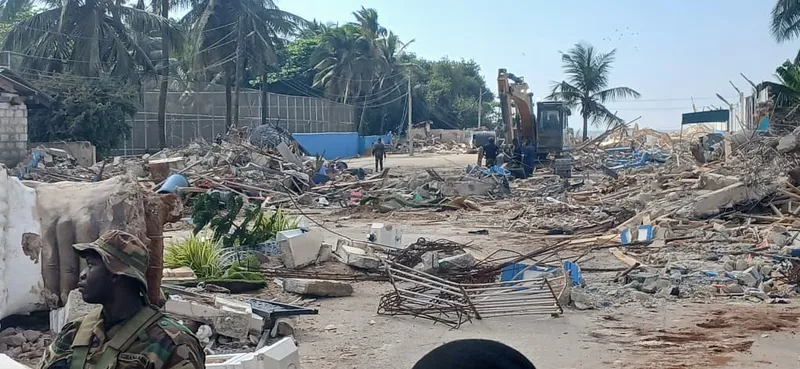
The Mahama government’s handling of the Labadi Beach demolition is a masterclass in narrative failure. Instead of clear governance, we see a government scrambling to spin events, transforming property destruction into a public relations circus (Daily Graphic, 2026; JoyNews, 2026). Since when did demolitions become partisan showcases rather than legal matters? When victims, even after securing interlocutory injunctions, find no recourse in the courts, it signals a collapse of the rule of law (Gyimah-Boadi, 2017; Arthur, 2015). The role of “police and military personnel” as demolition contractors is a gross abuse of mandate—state resources are misused, and legal boundaries are trampled (Modern Ghana, 2026). When government action turns arbitrary, citizens are left with the political equivalent of a frog leaping from boiling water: intolerant, unstable, and desperate for justice.
This paper offers no defence for business owners who broke the law, nor for the official narrative of the Laboma demolition—one riddled with contradictions and sanitized falsehoods. Ghana cannot progress by institutionalizing lawlessness or by legitimizing corruption through bribes for planning documents, permits, or environmental approvals (Ayee, 2020; Ampratwum, 2008). Development rhetoric is now a smokescreen for elite self-enrichment, turning public policy into a tool for enriching a privileged few while the majority languish in poverty (Gyimah-Boadi, 2017; Aryeetey & Baah-Boateng, 2016).
On September 13, 2026, the Post Flood Mitigation Task Force and the Greater Accra Regional Security Council, backed by the Ghana Armed Forces’ 48 Engineer Regiment, razed businesses across the Laboma enclave, including the Pink Flamingo Lounge. The stated aim—flood mitigation and basin restoration—rings hollow, as the official justification is contested by business owners denied due process (Daily Graphic, 2026; MyJoyOnline, 2026).
The Task Force’s selective demolition, as justified by Deputy Chief of Staff Stanislav Xoese Dogbe, raises the question: what political or economic interests dictated which structures survived? Such arbitrary enforcement reflects a corrupt system where power, not law, determines outcomes. Until such abuses are confronted, Ghana’s development will remain a façade for elite predation and growing inequality (Transparency International, 2022; Owusu, 2023).
Dogbe’s narrative on the Labadi Beach demolition epitomizes the linguistic acrobatics Ghanaian officials employ to obscure the obvious and rationalize the indefensible (Daily Graphic, 2026; GhanaWeb, 2026). On Facebook, Dogbe insisted, “Let’s not get it twisted: Friday’s action along a section of the beach was not a flood-mitigation action by the government task force,” and instead claimed it was conducted by National Security at the behest of Labadi Beach Hotel (GhanaWeb, 2026).
This disingenuous wordplay—substituting “action” for “demolition”—is a classic maneuver to muddy public discourse and evade accountability (Gyimah-Boadi, 2017). The coincidence of simultaneous demolitions by different state actors, while legal challenges were pending, reveals a deliberate disregard for due process and a strategy of governance by obfuscation (Transparency International, 2022; MyJoyOnline, 2026).
Dogbe’s projection that others are “twisting” facts, while he himself twists the narrative, mirrors a broader political culture in which leaders, as John Dramani Mahama is alleged to have admitted in 2020, embrace deception as a governing tool: “If you have to lie to them, you do so, and this is our way of doing things as political actors” (Modern Ghana, 2020). Such admissions, even if disputed, expose the rot at the core of Ghanaian political communication—where truth is sacrificed for expediency, and public trust is the casualty.
Building on Dogbe’s invocation of “National Security,” one must ask: what does “National Security” actually mean, and what is its constitutional function? As any Security Studies 101 student knows, National Security is not a monolithic agency but a coordinated framework of institutions—military, police, immigration, and others—charged with ensuring national stability and peace (Constitution of Ghana, 1992, Art. 83; Aning, 2006). Dogbe and his ilk have reduced “National Security” to a partisan militia, staffed with irregulars and loyalists whose primary allegiance is to the sitting government, not the Ghanaian state (Aning & Lartey, 2022; Daily Graphic, 2023).
Decades of politicization have transformed what should be a national safeguard into a blunt instrument of executive power—used to intimidate, silence, and even unlawfully demolish businesses while legal proceedings are ongoing (Gyimah-Boadi, 2017; Transparency International, 2022). No serious democracy deploys its military against private citizens when cases are sub judice. The military’s role is to defend against external threats, not terrorize the domestic population for political convenience.
Pivoting to a critical document, the Board of Trustees of the Social Security and National Insurance Trust (SSNIT) issued a letter dated 2 October 2026, asserting its ownership of Labadi Beach Hotel and La Palm Royal Beach Hotel. SSNIT claimed it had called for urgent intervention from the National Security Council Secretariat to combat ongoing illegal occupation, encroachment, and unauthorized activities on beachfront property adjacent to these hotels (Daily Graphic, 2026; GhanaWeb, 2026).
The agency cited escalating threats to guest and employee safety, unauthorized access to sensitive areas, fire and sanitation risks, environmental destruction, and the erosion of hotel privacy and operations—all jeopardizing revenue and financial sustainability. SSNIT warned that unchecked encroachment would make land recovery increasingly difficult and costly, underscoring the gravity of the situation and its broader implications for public asset management (MyJoyOnline, 2026; Transparency International, 2022).
Turning to the heart of the matter, while SSNIT—like any legal entity—has the right to defend its property, bypassing judicial remedies and resorting to state force before securing an interlocutory injunction is nothing short of corporate lawlessness (Aning, 2006; Daily Graphic, 2026). When did SSNIT first perceive such an acute threat as to warrant direct national security intervention? The suspicious haste with which armed personnel demolished multimillion-dollar properties reeks of political manipulation and a shadowy agenda (Gyimah-Boadi, 2017; GhanaWeb, 2026).
The swiftness and violence of the Labadi demolitions suggest more than routine enforcement—it signals abuse of state machinery for partisan retribution. The viral video of CEO Raymond Archer, lamenting tit-for-tat demolitions targeting opposition businesses, only reinforces public suspicion of politically motivated vendettas (MyJoyOnline, 2026). This cycle of vindictiveness, where justice is equated with revenge, undermines the rule of law and deepens national cynicism (Transparency International, 2022; Owusu, 2023). By allowing SSNIT and National Security to circumvent legal process, the Mahama administration is complicit—whether by direct orchestration or willful neglect. This is governance by vendetta, not by law. History will judge whether the president’s claim that Ghanaians have “short memory” proves prophetic; the 2028 elections will offer the verdict.
In closing, Ghanaian politics since the advent of the Fourth Republic has degenerated into a vicious cycle of vendetta—“an eye for an eye, tooth for a tooth,” or more aptly, “boot for boot.” Once admired for its democratic sanity, Ghana is now defined by the NDC and NPP’s relentless campaigns to undermine each other, prioritizing political score-settling over the urgent needs of citizens (Gyimah-Boadi, 2017; Arthur, 2015). This toxic rivalry has reduced governance to a zero-sum game, with public welfare relegated to an afterthought (Ayee, 2020; Daily Graphic, 2026).
Let us not mince words: politics in Ghana is now economics by other means. With rare exceptions—such as Dan Botwe—politicians are motivated by personal gain, eagerly attaching themselves to the corporate gravy train while their constituents languish (Transparency International, 2022; Owusu, 2023). Morality in Ghanaian politics ends where financial interests begin. Unless citizens wake up and scrutinize official narratives, the nation will remain stuck in mediocrity and corruption. The Laboma demolition is not an outlier; it is a symptom of a deeper malaise.
References
Ampratwum, E. F. (2008). The fight against corruption and its implications for development in Ghana. Journal of Money Laundering Control, 11(1), 67-83.
Aning, K. (2006). Security, the State, and the Politics of Protection in Ghana. African Affairs, 105(419), 419-436.
Aning, K., & Lartey, E. (2022). The Politicization of National Security in Ghana. African Security Review, 31(1), 15-29.
Arthur, J. (2015). Political corruption and public accountability in Ghana. African Journal of Public Affairs, 8(2), 34-48.
Aryeetey, E., & Baah-Boateng, W. (2016). Understanding Ghana’s growth success story and job creation challenges. Brookings Africa Growth Initiative.
Ayee, J. R. A. (2020). Political economy of rule of law in Ghana. African Affairs, 119(475), 557-577.
Constitution of the Republic of Ghana (1992), Art. 83.
Daily Graphic. (2026, October 3). SSNIT claims ownership of Labadi and La Palm hotels amid demolition row. https://www.graphic.com.gh/news/general-news/ssnit-claims-ownership-of-labadi-la-palm-hotels-amid-demolition.html
Daily Graphic. (2026, September 14). Flood mitigation or land grab? Laboma demolition controversy deepens. https://www.graphic.com.gh/news/general-news/flood-mitigation-or-land-grab-laboma-demolition.html
Daily Graphic. (2026, September 14). Flood mitigation or land grab? Laboma demolition controversy deepens. https://www.graphic.com.gh/news/general-news/flood-mitigation-or-land-grab-laboma-demolition.html
Daily Graphic. (2026, April 18). Government under fire over Labadi Beach demolition. https://www.graphic.com.gh/news/general-news/government-under-fire-over-labadi-beach-demolition.html
Daily Graphic. (2023, May 22). National Security—State protector or government enforcer? https://www.graphic.com.gh/news/general-news/national-security-state-protector-or-government-enforcer.html
GhanaWeb. (2026, October 4). SSNIT demands National Security intervention over Labadi Beach encroachment. https://www.ghanaweb.com/GhanaHomePage/business/ssnit-demands-national-security-intervention-over-labadi-beach-encroachment-2026
GhanaWeb. (2026, September 15). Dogbe clarifies Labadi Beach demolition: Not a flood-mitigation exercise. https://www.ghanaweb.com/GhanaHomePage/NewsArchive/Dogbe-clarifies-Labadi-Beach-demolition-Not-a-flood-mitigation-exercise-2026
Gyimah-Boadi, E. (2017). Corruption in Ghana: Trends, causes, and consequences. Ghana Center for Democratic Development.
JoyNews. (2026, April 19). Victims of Labadi demolition left in legal limbo. https://www.myjoyonline.com/victims-of-labadi-demolition-left-in-legal-limbo/
Modern Ghana. (2026, April 20). National Security oversteps mandate in Labadi Beach demolition. https://www.modernghana.com/news/1432567/national-security-oversteps-mandate-in-labadi-beach-demol.html
Modern Ghana. (2020, October 5). Mahama’s confession: Politicians must sometimes lie to win public support. https://www.modernghana.com/news/1033499/mahamas-confession-politicians-must-sometimes-lie.html
MyJoyOnline. (2026, October 5). SSNIT raises alarm over threats to hotel operations at Labadi Beach. https://www.myjoyonline.com/ssnit-raises-alarm-over-threats-to-hotel-operations-at-labadi-beach/
MyJoyOnline. (2026, September 16). Legal wrangling continues over Laboma demolitions. https://www.myjoyonline.com/legal-wrangling-continues-over-laboma-demolitions/
MyJoyOnline. (2026, September 15). Business owners dispute Laboma demolition notices; court battle looms. https://www.myjoyonline.com/business-owners-dispute-laboma-demolition-notices-court-battle-looms/
Owusu, G. (2023). Electoral populism and the hollowing out of policy in Ghana. Journal of African Elections, 22(2), 41-56.
Transparency International. (2022). Corruption Perceptions Index 2022: Ghana. https://www.transparency.org/en/cpi/2022/index/gha
