
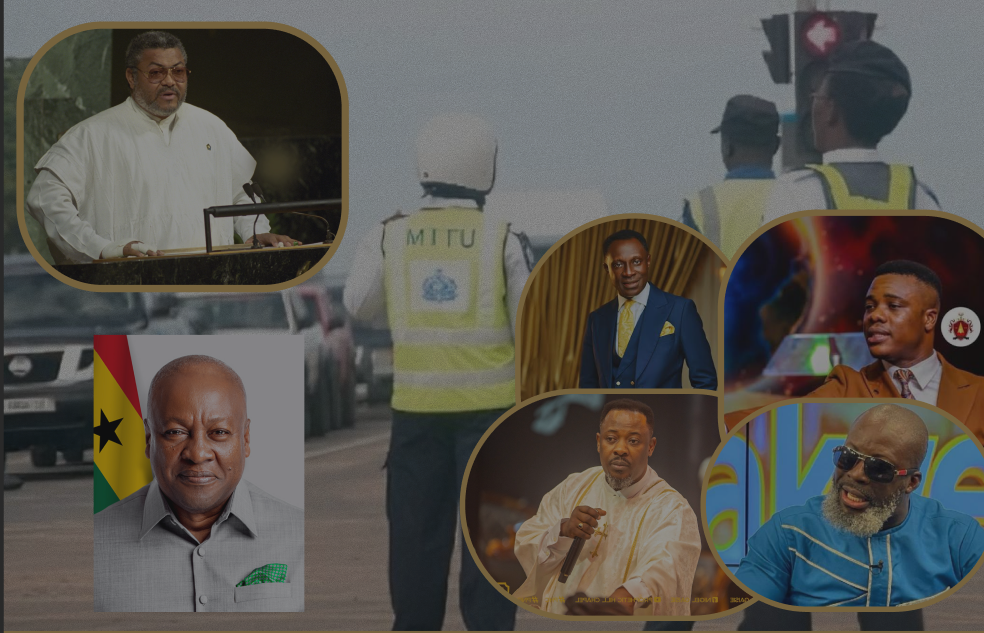
In this paper, I confront President John Dramani Mahama’s chronic indecisiveness on policy and law. Lawlessness thrives in a vacuum, and Mahama’s pacifist approach reeks of weak leadership—an open invitation for corporate pastors and conmen to assert unconstitutional authority (Gyimah-Boadi, 2017; Arthur, 2015). By tolerating pastors who act as parallel power brokers, Mahama enables and emboldens them to challenge the very legitimacy of the state, dragging the presidency into public ridicule and eroding the rule of law (Ayee, 2020; Daily Graphic, 2024). This abdication of responsibility is not mere oversight; it is a failure of governance that undermines constitutional order and national stability.
President Mahama’s recent public defence of Regulation 141—The Road Traffic Regulations, 2026 (LI 2519)—banning preaching and hawking in public transport, was clear: the law targets moving vehicles for road and passenger safety (Daily Graphic, 2026). Yet, his subsequent claim that the law does not apply to stationary vehicles betrays both legal illiteracy and political cowardice. Floating the prospect of “further consultation” on an already-enacted regulation is not just bad policy—it is an abdication of leadership, signalling to offenders that the law is negotiable and open to partisan bargaining (Arthur, 2015; Gyimah-Boadi, 2017). Such equivocation invites confusion and undermines the credibility of legal enforcement.
Turning to Ghana’s self-styled pastors: Who are they to challenge the authority of the state on matters of law? As Rawlings once put it, “who born dog?” If these sanctimonious brigands in ill-fitting suits truly sought legal clarity, they would take the regulation to court—not incite defiance and urge their followers to break the law (Daily Graphic, 2026; Gyimah-Boadi, 2017). Rev. Dr. Kwadwo Benjamin’s claim that Regulation 141 targets Christianity is not only baseless but intellectually bankrupt. Would Bempah dare demand that the US or UK allow preachers to disrupt flights with unsolicited sermons? His reckless call for pastors to preach in defiance of the law is an affront to both legal order and public decency (Arthur, 2015; BBC News, 2023). That the NDC government hesitates to enforce the law or clarify its stance is a further indictment of its leadership. Weak governance emboldens lawlessness and erodes public respect for both state and faith.
At his Ridge Residence, Rawlings did not mince words about Ghana’s new generation of pastors. Speaking in Anlo, he questioned why God would inflict the country with figures like Daniel Obinim and Nicholas Osei (Kumchacha)—the latter he mockingly mispronounced as “KumKasa,” meaning “Talk of Death” or “Connish Talk” (YouTube, 2017). In palpable anguish, Rawlings denounced these so-called spiritual leaders as magicians with the venom of serpents, lamenting the cacophony and absurdity they bring to public discourse (Daily Graphic, 2018; Modern Ghana, 2023). Rawlings was unyielding: if such men attract crowds, something is fundamentally broken in the national psyche. He condemned Ghanaians as “consumers of moral filth”—a scathing, and wholly justified, indictment of contemporary religious culture (Gyimah-Boadi, 2017).
Building on the toxic intersection of religion and politics in Ghana, Nigel Gaisie’s brazen defiance of Regulation 141—The Road Traffic Regulations, 2026 (LI 2519)—declaring on Facebook, “I will be on buses and lorries to preach… Let them come and arrest me”—is no accident (GhanaWeb, 2026). Gaisie, self-styled Prophet of the NDC and confidant of President Mahama, flaunts a sense of untouchable entitlement, convinced that his spiritual theatrics delivered the party’s electoral victory (Daily Graphic, 2026; Modern Ghana, 2026). His arrogance—daring the state to enforce the law—reflects the toxic nexus of religion and politics in Ghana, where spiritual charlatans wield unchecked influence over government (Gifford, 2015; Asamoah-Gyadu, 2015).
Gaisie is not an outlier; he is the logical product of a system that rewards sycophancy and grants immunity to those who feed the political machine. As the African proverb goes, “He who owns and feeds the sheep can lead it to the slaughterhouse at will.” In Ghana’s case, the sheep—the NDC—bleats in vain, powerless against the shepherd’s ambition.
Continuing this pattern of intellectual bankruptcy, Rev. Telvin Sowah Adjei stooped to the familiar tactic of equating preaching in public vehicles with playing music—a juvenile, false equivalence often brandished by those incapable of substantive debate (Asamoah-Gyadu, 2015; Gifford, 2015). Rather than presenting evidence-based arguments, Adjei and his ilk default to loud, fact-free rhetoric, spiced with biblical snippets to manipulate listeners’ fears and cling to dwindling influence (BBC News, 2023). For these pastors, oratory and rote scripture recitation pass for divine anointment, culminating in the empty platitude, “ye shall not touch the anointed of God,” met with rote “Amen” from an entranced congregation. This is not spiritual leadership; it is performative manipulation masquerading as faith.
Breaking from the narcissistic theatrics of his peers, Kumchacha deserves rare credit for upholding the rule of law, asserting that “the law is the law” and that scripture commands obedience to legal authority (Daily Graphic, 2026). Yet, his dissent is not rooted in political courage but in calculated self-preservation; he knows his survival depends on staying in the NDC’s good graces and would never jeopardize his financial lifelines by crossing the party line (Gyimah-Boadi, 2017; Gifford, 2015). In Ghana’s ruthless political landscape, dissent against the prevailing narrative is swiftly met with economic retribution, making Kumchacha’s compliance less about principle and more about pragmatism.
In conclusion, by goading the NDC and Mahama into a public showdown, Ghana’s pastors are sending a brutal message: those who lie with dogs will get fleas. The spectacle of President Mahama kneeling before these so-called men of God—begging for electoral blessings in exchange for perks, plum appointments, and empty promises of a national cathedral—was political theatre at its most craven (Daily Graphic, 2026). These clergy, masquerading as spiritual giants, are little more than opportunists wielding threats and extracting concessions by exploiting political vulnerability (Gifford, 2015; Asamoah-Gyadu, 2015). The government’s failure to confront these bluffing criminals has only emboldened them, creating parallel power structures that threaten national security and undermine state authority (Gyimah-Boadi, 2017). The lesson is clear: any politician who courts the church for electoral gain becomes a captive—forever talked down to, defied, and ultimately enslaved by those they once empowered.
References
Arthur, J. (2015). Political corruption and public accountability in Ghana. African Journal of Public Affairs, 8(2), 34-48.
Asamoah-Gyadu, J. K. (2015). Sighs and Signs of the Spirit: Ghanaian Perspectives on Pentecostalism and Renewal in Africa. Regnum Books International.
Ayee, J. R. A. (2020). Political economy of rule of law in Ghana. African Affairs, 119(475), 557-577.
BBC News. (2023, August 12). Ghana’s charismatic pastors and the limits of legal authority. https://www.bbc.com/news/world-africa-66499432
Daily Graphic. (2026, October 10). Mahama’s prayer rally and clergy’s rising influence. https://www.graphic.com.gh/news/politics/mahamas-prayer-rally-and-clergys-rising-influence.html
Daily Graphic. (2026, May 24). Prophet Nigel Gaisie dares government over bus preaching ban. https://www.graphic.com.gh/news/general-news/prophet-nigel-gaisie-dares-government-over-bus-preaching-ban.html
Daily Graphic. (2026, May 22). President clarifies ban on preaching, hawking in public transport. https://www.graphic.com.gh/news/general-news/president-clarifies-ban-on-preaching-hawking-in-public-transport.html
Daily Graphic. (2024, March 15). Pastors challenge President Mahama: A crisis of authority. https://www.graphic.com.gh/news/politics/pastors-challenge-president-mahama-a-crisis-of-authority.html
Daily Graphic. (2018, June 18). Rawlings slams new crop of Ghanaian pastors. https://www.graphic.com.gh/news/general-news/rawlings-slams-new-crop-of-ghanaian-pastors.html
GhanaWeb. (2026, May 23). Nigel Gaisie vows to defy public transport preaching ban. https://www.ghanaweb.com/GhanaHomePage/NewsArchive/Nigel-Gaisie-vows-to-defy-public-transport-preaching-ban-2026
Gifford, P. (2015). Christianity, Development and Modernity in Africa. Hurst & Company.
Gyimah-Boadi, E. (2017). Corruption in Ghana: Trends, causes, and consequences. Ghana Center for Democratic Development.
Modern Ghana. (2026, May 25). Nigel Gaisie’s challenge: Religion, politics, and the law. https://www.modernghana.com/news/1433100/nigel-gaisies-challenge-religion-politics-and-the-law.html
Modern Ghana. (2023, August 11). Prophet Kumchacha responds to Rawlings’ “KumKasa” jibe. https://www.modernghana.com/news/1386706/prophet-kumchacha-responds-to-rawlings-kumkasa-jibe.html
YouTube. (2017, July 20). J J Rawlings takes on Obinim and Kumchacha [Video]. https://www.youtube.com/watch?v=Ue9lA6p3t70
