
Recent calls by Black South Africans for undocumented African immigrants to leave their country, though painful, are not without justification. The xenophobic rhetoric—“kwerekwere, go back and fix your country”—emerges from frustration with government inaction on unemployment and the visible, sometimes illicit, success of some migrants (Crush & Ramachandran, 2014). While the violence and deaths inflicted upon immigrants are indefensible and constitute a national shame, the underlying grievances speak to a leadership vacuum and state failure (Dodson, 2010).
This paper, however, does not focus on South African youth unemployment; that is a crisis for another discussion. My concern is Ghana’s youth unemployment epidemic, the charade of government policies, and the existential threat this malaise poses to national security. Data, often sanitized for political expediency, fails to capture the lived hopelessness on Accra’s streets. It is not hyperbole to state that the next fall of government in Ghana will not come from a tired military, but from a weaponized youth whose aspirations have been battered by official neglect and empty slogans (Ayee, 2019).
Ghana’s independence in 1957 was a beacon for Africa, a promise of self-determination under Kwame Nkrumah’s visionary leadership. Nkrumah understood that national development rested on education and youth employment. His seven-year plan was not mere rhetoric but a blueprint for prosperity—sabotaged by the anti-Nkrumah coup and the slavish obedience of the National Liberation Council to neo-colonial handlers (Biney, 2011). Nkrumah’s legacy built the foundation for generations—including current leaders—who now preside over a decaying system.
Since the Fourth Republic began in 1993, Ghana has lacked genuine visionaries. The nation produces rulers, not leaders; sloganeers, not planners. Youth employment initiatives exist as patronage schemes reserved for party loyalists—hollow promises designed to pacify, not empower (Ayee, 2019). Jerry Rawlings and his successors have excelled at distributing crumbs to the youth, transforming them into sycophants rather than nation-builders.
President Mahama’s government is a master class in overpromising, under-delivering, and exporting Ghana’s youth to foreign labour markets for remittances. These policies are a cynical exploitation of desperation. The government’s boastful announcements—about exporting youth to boost foreign reserves—are a grotesque abdication of responsibility. Out of sight, out of mind: this is how the Mahama administration treats the unemployment crisis.
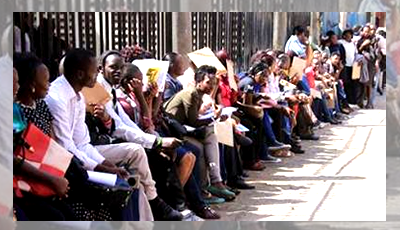
A drive through Accra shatters the official narrative. The streets teem with young hawkers—graduates of broken dreams, forced into hustling for survival. For many, digital innovation means online scams, justified by the rational calculation that life as a prisoner in the West is preferable to starving at home. Such criminal recourse is not a moral failing of the youth, but an indictment of a state that has abdicated all responsibility (Aning & Edu-Afful, 2015). This narrative is not rare—it is the rule. The government’s refusal to confront youth unemployment is a ticking time bomb. No amount of propaganda or political theatre will shield the president or his cronies. Power flows from the people, and when hope evaporates, no regime is safe.
Illegal mining stands as the most visible “job creation” scheme in rural Ghana. The government turns a blind eye as young men—unemployed, desperate, and often violent—flock to galamsey sites. The environmental carnage is permanent, but the response from the youth is callous: “we need our daily bread.” The state’s tacit endorsement of mineral laundering, as evidenced by Gold Board CEO Sammy Gyamfi’s encouragement of legal and illegal mining, reveals the bankruptcy of national vision (Hilson, 2017).
The nation’s night and moral economy: the sale of bodies by young girls on the streets of Accra constitutes a deliberately ignored crisis—a taboo so profound that politicians would rather suffocate the discourse than confront its uncomfortable truths (Amoah, 2021). Ghana, once celebrated for its commitment to raising morally upright girls, now faces a crisis born from systemic unemployment and economic hardship, pushing young women into prostitution out of necessity to supplement family incomes (Gyan, 2020). This is not merely a social aberration but a grim indictment of political lethargy and indifference. The perils attached—including violence, exploitation, and the proliferation of sexually transmitted diseases like HIV/AIDS—are realities so pervasive that the nation’s complacent politicians not only fail to address them, they actively avoid them (Owusu & Asante, 2022). Family houses in low-income neighbourhoods, once sanctuaries for kinship and support, have been reduced to dual-purpose structures: simultaneously providing shelter and serving as informal brothels, a transformation emblematic of a society abandoned by its leaders.
The Mahama government’s defence of environmental destruction in the name of job creation is a betrayal of both youth and future generations. In Ghana, money trumps nature. The absence of a binding national development plan means each administration torpedoes its predecessor’s initiatives for cheap political gain. The so-called “free education” policy—imperfect but vital—has been shredded by partisan rivalry, only to be later embraced when power changes hands.
Ghana’s youth unemployment crisis is not a policy problem; it is an indictment of a political class that lacks both the will and the imagination to govern. Unless this malaise is confronted with urgency and seriousness, the consequences will be catastrophic—not only for the ruling elite but for the entire nation.
References
Amoah, E. (2021). Politics of silence: Gender, morality, and street survival in Accra. Ghana Social Science Review, 38(2), 45-67.
Aning, K., & Edu-Afful, F. (2015). Ghana’s youth and violent extremism: Policy approaches and options. Institute for Security Studies.
Ayee, J. R. A. (2019). Politics, governance, and development in Ghana. Rowman & Littlefield.
Biney, A. (2011). The political and social thought of Kwame Nkrumah. Palgrave Macmillan.
Crush, J., & Ramachandran, S. (2014). Xenophobic violence in South Africa: Denialism, minimalism, realism. Migration Policy Series, 66. Southern African Migration Programme.
Dodson, B. (2010). Locating xenophobia: Debate, discourse, and everyday experience in Cape Town, South Africa. Africa Today, 56(3), 2–22.
Gyan, C. (2020). Economic hardship and female youth in Ghana: Coping with limited opportunities. International Journal of African Development, 7(1), 112-129.
Hilson, G. (2017). Shootings and burning excavators: Some rapid reflections on the government of Ghana’s handling of the galamsey mining ‘menace’. Resources Policy, 54, 166–172.
Owusu, K., & Asante, R. (2022). HIV/AIDS risk and neglected populations in urban Ghana. Journal of Public Health in Africa, 13(3), 233-245.
