
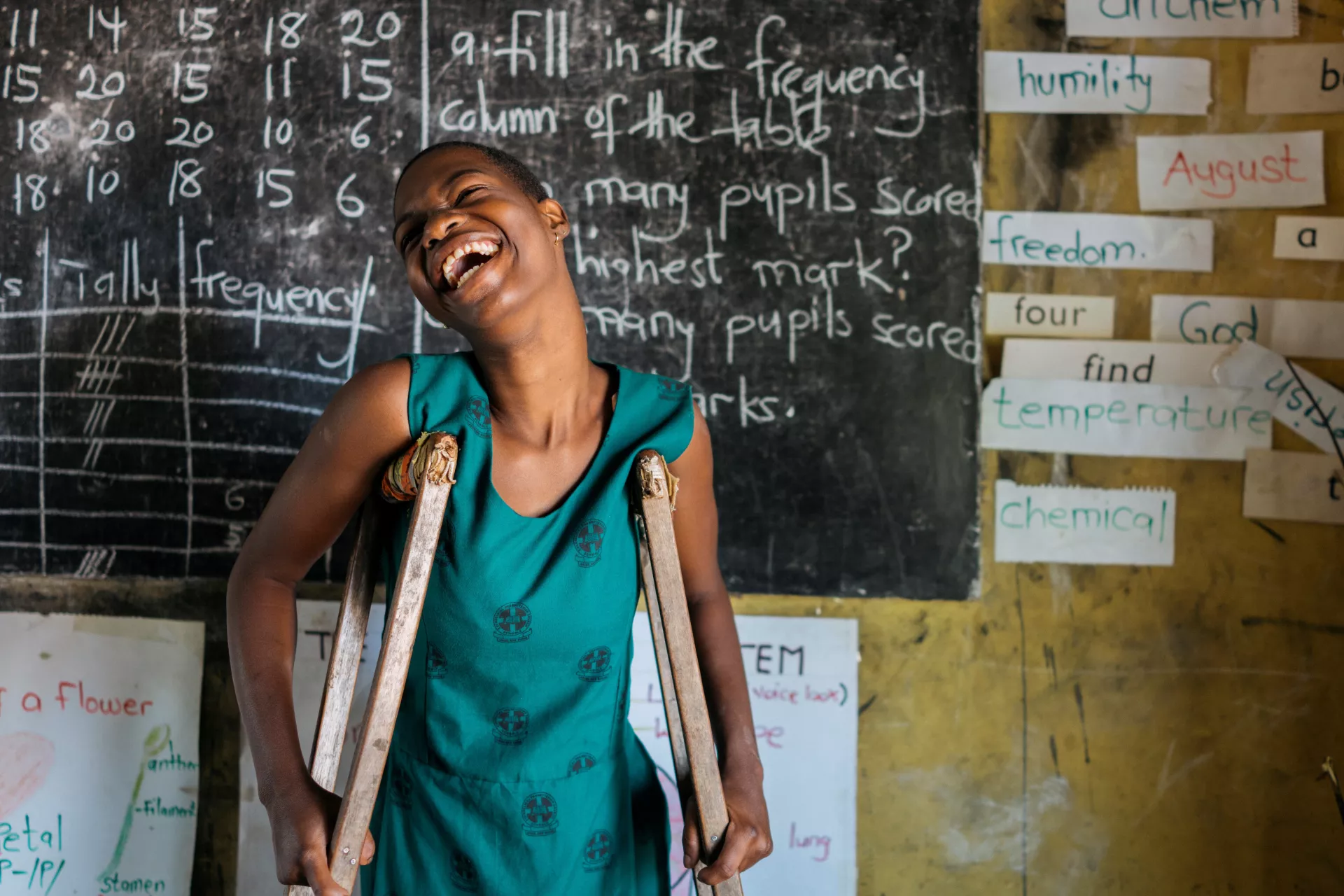
In this publication, I interrogate a subject that is not only personally significant but also a litmus test for the ethical maturity of our nation: the treatment of disabled students within the Ghanaian education system. I do not merely observe the state of public education for disabled students; I challenge the inertia, the apathy, and the deeply entrenched prejudices that have permitted the continued marginalization of this population. Through direct engagement with members of the public, I have gathered views that corroborate a disturbing reality: the state’s failure to meaningfully integrate disabled students into the general student population is not an oversight, but a persistent institutional deficiency.
To call Ghana a “civilized nation” is to invoke a standard that carries weight and consequence. Civilization, as I employ the term, is not a matter of mere economic development or rhetorical commitment to progress; it demands a leadership that understands and enacts equity and social justice across all sectors, most crucially in public education (Sen, 2009). A civilized nation provides the necessary resources and support to ameliorate the lived experience of its most vulnerable members—disabled students included.
Let us be clear: the problem facing disabled students in Ghana has never truly resided in their physical conditions. The limitations they encounter are manufactured and perpetuated by a society that chooses pity over policy, charity over rights, and segregation over integration (Oliver, 1996). After sixty-nine years of independence, it is nothing short of an indictment that the Ghanaian public continues to tolerate, if not tacitly endorse, an educational system that excludes rather than includes. The responsibility for remedying this disgrace does not rest on the shoulders of disabled students, but on the state and its citizens—on all of us who have failed to demand and deliver substantive reform (WHO, 2011).
Despite the Ghana Education Service’s investments in programs such as the school feeding initiative for economically disadvantaged students and its promotion of Science, Technology, Engineering, and Mathematics (STEM) education—both commendable yet chronically underfunded efforts—the glaring omission of disability education in both policy and public communication is indefensible. An examination of the sector’s official website reveals a troubling silence: under the “service and resources” section, disability education is virtually invisible, and scant attention is paid to the operational realities of schooling for students with disabilities (Ametepee & Anastasiou, 2015).
This lack of transparency and institutional commitment is not a benign oversight; it is a deliberate perpetuation of exclusion. The absence of substantive information about disability rights, resources, and the Service’s vision for disabled students signals a tacit acceptance of the status quo. Such institutional neglect leaves disabled students not only vulnerable during their schooling years, but also ill-prepared and unsupported as they transition into adulthood and the workforce (Anthony, 2011).
This silence on disability education is, frankly, a reflection of misplaced priorities and a failure to recognize the fundamental rights of disabled students to equitable participation and opportunity. It is high time that the leadership of the Ghana Education Service shift from token gestures to actionable, transparent policies that place disability rights and inclusion at the forefront of educational reform (UNESCO, 2020).
My recent examination of the Ministry of Education’s official website revealed a distressing lack of substantive information on disability education. Not only was detailed content absent, but technical failures often rendered the site inoperable, further impeding access to whatever limited resources might exist (Ministry of Education, Ghana, 2026). This digital opacity is not merely an inconvenience; it is emblematic of a broader institutional indifference that should provoke public outrage. While alternative platforms such as educateghana.com provide general overviews of inclusive and special education, their content is superficial at best, offering definitions and policy timelines without disclosing essential data—such as enrollment numbers in special education programs or documented strategies for integration (Inclusive Education in Ghana: Complete Guide | EducationGhana, 2024).
This pattern of obfuscation is not accidental. The Ministry’s own communications are saturated with the obvious—reciting the 2015 inception of the Inclusive Education Policy, reiterating vague goals, and offering platitudes about commitment to equity—yet they conspicuously avoid actionable specifics or measurable outcomes (Ministry of Education, Ghana, 2026). For any serious observer, this is not merely disappointing; it is a tacit endorsement of inertia. In an era when nations worldwide are making bold moves to integrate disabled students into mainstream classrooms, Ghana’s education authorities remain mired in rhetorical posturing, evidently content to define the problem rather than resolve it (UNICEF, 2021).
It is time to demand more than definitions and declarations. The absence of transparency and the refusal to articulate a concrete, data-driven roadmap for disability education reform is an affront to the values of inclusion and justice. Ghanaians deserve not only to be told what inclusive education is, but to see clear evidence of progress and a credible plan for the future.
The posture adopted by both the Ghana Education Service and the Ministry of Education regarding disability education, as revealed through their conspicuous silences and lack of substantive content on their official websites, is the very definition of what Ahmed (2012) identifies as “lip service.” This is not merely a matter of administrative oversight; it is a calculated strategy to mollify parental concern and public outcry without delivering real progress or accountability (Ahmed, 2012; Ghana Education Service, 2026; Ministry of Education, Ghana, 2026).
The websites of these pivotal institutions, which should serve as platforms for transparency and leadership in inclusive education, instead offer little more than perfunctory statements and recycled commitments, devoid of actionable plans or measurable outcomes (Ghana Education Service, 2026; Ministry of Education, Ghana, 2026). This pattern of performative advocacy is deeply troubling—especially in a national context where the need for robust inclusion and equity frameworks is urgent and non-negotiable (Mantey, 2017).
By retreating into rhetoric, the Service and Ministry have made a mockery of genuine reform, signalling to disabled students and their families that their right to equitable education is negotiable, secondary, and ultimately expendable. Such a stance is not only ethically indefensible but also institutionally regressive, perpetuating the very marginalization these agencies are tasked to eradicate.
While the intention of this paper is not to castigate the Ghana Education Service or the Ministry of Education—particularly in light of their well-documented budgetary constraints—it is an unapologetic demand for transformative policy reform that centers the educational rights of all students, including those with disabilities (Ghana Education Service, 2026; Ministry of Education, Ghana, 2026). Mere acknowledgment of fiscal limitations cannot continue to serve as a refuge for inaction. In the twenty-first century, educational leadership requires the courage to disrupt outdated paradigms and the will to design systems that prioritize inclusion over exclusion (Slee, 2018).
Policymakers must return to the drawing board and craft comprehensive frameworks that are genuinely inclusive. This imperative extends far beyond rhetorical commitments; it necessitates a radical overhaul of teacher education programs, with disability education established as a core pillar of the curriculum. The faculties of education at Ghana’s universities must be retooled and resourced so that pre-service teachers emerge with the competence and conviction to view disability not as a deficit, but as a social marker of difference—a dimension of diversity that enriches, rather than burdens, the classroom experience (Forlin & Chambers, 2011; Slee, 2018). Ultimately, the call is for a national ethos that celebrates diversity as an asset and positions disability education at the heart of pedagogical practice and policy design. Only then can Ghana’s education system claim the mantle of equity and justice it so frequently invokes.
However severe Ghana’s fiscal constraints may be, the government’s obligations to students with disabilities are neither optional nor negotiable. The state bears a moral, constitutional, and indeed a “paternal” responsibility to guarantee equitable and inclusive education for all, including those most frequently relegated to the periphery (Ghana Education Service, 2026; Ministry of Education, Ghana, 2026; Constitution of the Republic of Ghana, 1992). The persistent marginalization of special education students under the guise of limited resources is a dereliction of duty that cannot be excused.
Critical education scholars rightly argue that the rights of students with disabilities are indivisible from those of every other Ghanaian child—they are universal, inalienable, and demand equal protection and enactment (Armstrong et al., 2010). A society, and by extension its institutions, that respects and upholds the dignity of all its citizens is a society that inspires civic participation, loyalty, and collective advancement (Banks & Banks, 2019). The Ghana Education Service and the Ministry of Education, as stewards of the nation’s future, are not exempt from this imperative.
To abandon this fundamental injunction is to cultivate a climate of indifference and social withdrawal—a citizenry that turns inward in the face of communal need and neglects its highest aspirations. Such a trajectory is not merely lamentable; it is antithetical to nation-building and to the very ideals upon which Ghana’s educational and constitutional frameworks rest. Policymakers are thus enjoined, in the strongest terms, to reject complacency and prioritize inclusive education as an ethical, legal, and national imperative.
References
Ahmed, S. (2012). On being included: Racism and diversity in institutional life. Duke University Press.
Ametepee, L. K., & Anastasiou, D. (2015). Special and inclusive education in Ghana: Status and progress, challenges and implications. International Journal of Educational Development, 41, 143-152.
Anthony, J. H. (2011). Conceptualising disability in Ghana: Implications for EFA and inclusive education. International Journal of Inclusive Education, 15(10), 1073-1086.
Armstrong, F., Armstrong, D., & Spandagou, I. (2010). Inclusive education: International policy & practice. Sage.
Banks, J. A., & Banks, C. A. M. (2019). Multicultural education: Issues and perspectives (10th ed.). Wiley.
Constitution of the Republic of Ghana. (1992). https://www.parliament.gh/constitution
Forlin, C., & Chambers, D. (2011). Teacher preparation for inclusive education: Increasing knowledge but raising concerns. Asia-Pacific Journal of Teacher Education, 39(1), 17-32.
Ghana Education Service. (2026). https://ges.gov.gh/
Inclusive Education in Ghana: Complete Guide | EducationGhana. (2024). https://educationghana.org/inclusive-education-in-ghana-complete-guide/
Mantey, E. E. (2017). Discrimination against children with disabilities in mainstream schools in Southern Ghana: Challenges and perspectives from stakeholders. International Journal of Educational Development, 54, 18-25.
Ministry of Education, Ghana. (2026). https://www.moe.gov.gh/
Oliver, M. (1996). Understanding disability: From theory to practice. Macmillan.
Sen, A. (2009). The idea of justice. Harvard University Press.
Slee, R. (2018). Inclusive education isn’t dead, it just smells funny. Routledge
UNICEF. (2021). Seen, counted, included: Using data to shed light on the well-being of children with disabilities. https://www.unicef.org/reports/seen-counted-included-children-with-disabilities
UNESCO. (2020). Global education monitoring report 2020: Inclusion and education: All means all. UNESCO.
World Health Organization. (2011). World report on disability. WHO Press.
