
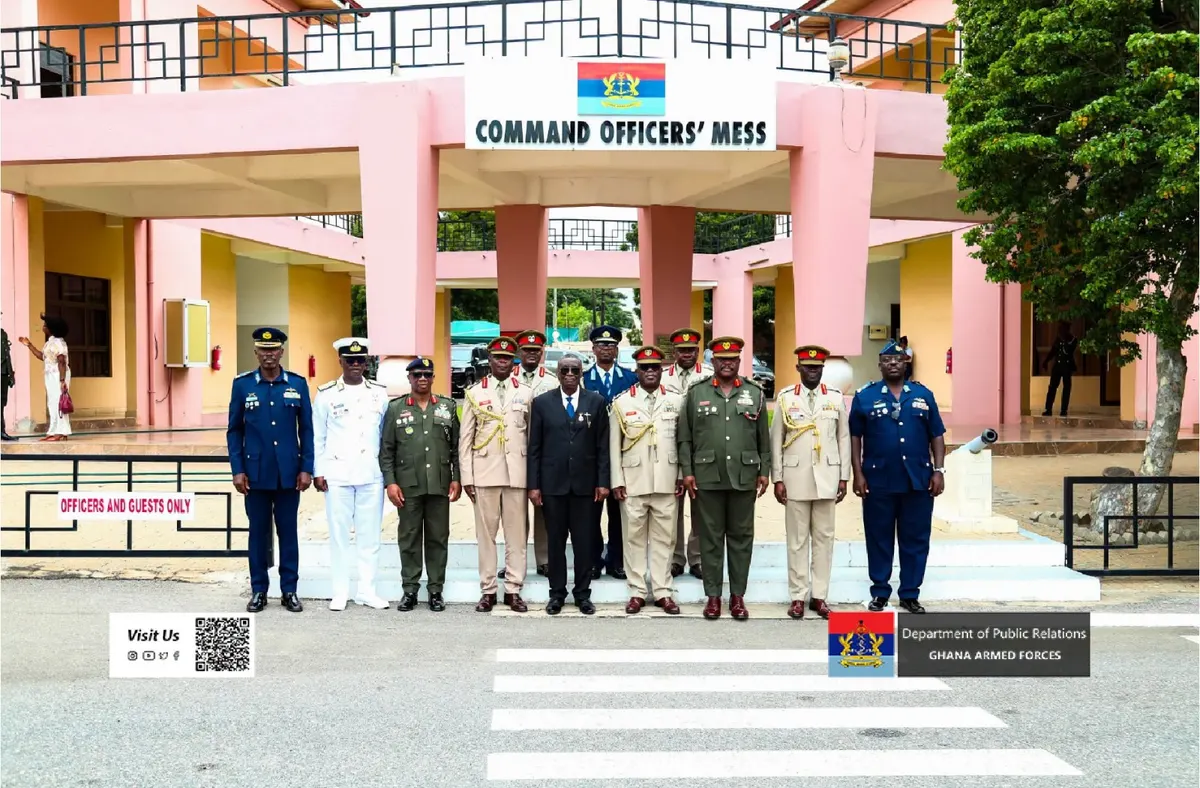
I begin this essay with a note of lamentation: If tears could mend a nation, I would weep a well for Ghana—a country that has lost the will to speak truth and instead crafts its own undoing. This paper sharply scrutinizes the recent, extravagant send-off for seven retiring generals and an air force commodore. While their service may be acknowledged, the necessity of such a publicized celebration, complete with envelopes of perks, is deeply questionable (Daily Graphic, 2026). What message does this send to the nation’s teachers—pillars of intellectual growth—and other dedicated public servants who continue to endure salary arrears and neglect? Such spectacles valorize privilege and hierarchy, while the true stewards of Ghana’s future are left abandoned and unrecognized.
This paper is not an assault on military tradition; rather, it exposes the stark disparity between the grand send-offs for retiring generals and the neglect of teachers and public servants—the true backbone of national development. Elevating military ceremonies while minimizing the invaluable contributions of educators and civil servants is unjustifiable and demands urgent national debate (Gyampo, 2021; Arthur, 2015). Such practices reinforce a culture of hierarchy and privilege, undermining meritocracy and the principle of equal recognition for service to the nation.
On 26 September 2026, the Ghana Armed Forces honoured seven retiring generals and an air commodore with a formal parade at Burma Camp, attended by top military brass and dignitaries. While ceremonial recognition is standard, the author finds it ethically indefensible that, beyond citations, each officer received 20,000 Ghanaian Cedis and lavish gifts—including high-end electronics and luxury items—donated by corporate elites such as Michael Zormelo and Francis Biney (Daily Graphic, 2026). The Ghana Armed Forces itself, in line with global best practices, limited its public contribution to plaques and citations.
These extravagant gifts from private businesses to high-ranking officers raise serious questions about undue influence and the erosion of military ethics (Gyampo, 2021; Arthur, 2015). Such gestures risk casting the Armed Forces as susceptible to bribery, recalling the public outrage over judicial corruption revealed in Anas Aremeyaw Anas’s investigation (Anas, 2015). Meanwhile, teachers and public servants—unpaid for months—must strike for basic recognition, reinforcing the perception that Ghana values hierarchy and patronage over genuine public service (Osei, 2017; Modern Ghana, 2024). These practices deepen mistrust and undermine the principles of meritocracy and integrity in national institutions.
President Mahama’s cash gifts to retiring officers, regardless of intent, reflect poor judgment and undermine the dignity of military service. By rewarding officers with money instead of meaningful citations, he reduces their legacy to mere patronage—reinforcing the corrosive notion that national service is measured by cash, not honour or inspiration for future generations (Gyampo, 2021; Arthur, 2015). Such gestures are not tokens of appreciation but thinly veiled acts of daylight bribery, eroding public trust in leadership and the Armed Forces (Daily Graphic, 2026; Anas, 2015).
Now to the hard questions: What drove the Ghana Armed Forces and these retiring generals and air commodore to accept gifts from the president and corporate entities? Where is the oversight—does the Armed Forces have an Ethics Officer or an effective Oversight Committee? Would military leadership tolerate a junior or non-commissioned officer accepting money from private individuals or companies, or would it provoke swift disciplinary action (Gyampo, 2021; Arthur, 2015)? Allowing senior officers with generous pensions to supplement their earnings via external gifts undermines military integrity and sets a dangerous precedent (Daily Graphic, 2026; Transparency International, 2023). The Directorate and Defence Ministry must urgently review and reform their policies on gifts, establishing clear, enforceable standards that shield the institution from undue influence and align with best practices globally (Transparency International, 2023; OECD, 2019). The credibility and honour of the Armed Forces must not be traded for cash or corporate favours.
Unlike the privileged ranks of the Ghana Armed Forces, teachers in Ghana are systematically marginalized by the Ministry of Education and the Ghana Education Service. These professionals—key to national socialization and human capital formation—are consigned to poverty wages, substandard living conditions, and harsh, remote postings (Akyeampong, 2017; Osei, 2017). Many teach under trees, buy their own teaching materials, and retire on incomes barely sufficient for a month’s survival (Daily Graphic, 2024; UNICEF, 2022). Delayed salaries are routine; teachers travel from distant regions to the Service’s headquarters, only to beg for overdue pay and receive empty promises (JoyNews, 2024).
The government and ministry leadership, shielded by their regular salaries and perks, treat teachers as expendable—echoing Marx’s critique of workers exploited to exhaustion (Aryeetey & Baah-Boateng, 2016). Strike threats are dismissed as childish tantrums, met with hollow reassurances to “exercise patience,” a euphemism for indefinite neglect. This persistent disregard has rendered teaching—once a noble profession—so unattractive that new graduates shun it entirely. The infantilization and exploitation of teachers is a national disgrace demanding urgent reform.
Transitioning to the issue of corruption, allegations of teacher misconduct—such as neglecting curriculum coverage and running exploitative private classes—are direct consequences of chronic policy failures by the Ministry of Education and the Ghana Education Service (Akyeampong, 2017; Aryeetey & Baah-Boateng, 2016). Neglected and underpaid, some teachers resort to unethical, even criminal, means to supplement their income, exploiting students and parents (Daily Graphic, 2024; UNICEF, 2022). The rot extends to the school placement and feeding programmes. Headmasters and headmistresses reportedly extort desperate parents for high-tier school admissions and exploit the feeding programme for personal gain by hiring relatives as matrons and siphoning food supplies for private resale (JoyNews, 2024; Modern Ghana, 2023). These scandals are symptomatic of systemic governance failures, not merely individual lapses.
In conclusion, Ghana’s crisis of public sector ethics and educational decline demands urgent, unapologetic reform. The Ghana Armed Forces must abolish extravagant send-off ceremonies for senior officers; those funds should support housing and welfare programs for junior ranks. Corporate and private gifts to officers should be banned outright, replaced by citations and plaques that honour genuine service, not patronage.
Teachers’ contracts must specify clear, enforceable terms of employment and payment—no more vague promises or bureaucratic evasions. The Ministry of Education and Ghana Education Service must slash wasteful spending on luxury vehicles, perks, and patronage contracts, redirecting resources to pay teachers promptly and fairly. It is time to end the empty rhetoric and confront pay inequity and salary arrears head-on. Ghana’s education system, once a continental model, is now in freefall, as reflected in soaring teacher attrition and abysmal exam results. The government’s inertia is indefensible; only radical, honest action—not wishful thinking—will reverse this decline and restore Ghana’s standing in Africa and beyond.
References
Anas, A. A. (2015, September 10). Ghana judges face suspension after bribe scandal. BBC News. https://www.bbc.com/news/world-africa-34204927
Akyeampong, K. (2017). Teacher motivation and quality education in Ghana: Lessons for policy and practice. International Journal of Educational Development, 55, 43-50.
Arthur, J. (2015). Political corruption and public accountability in Ghana. African Journal of Public Affairs, 8(2), 34-48.
Aryeetey, E., & Baah-Boateng, W. (2016). Understanding Ghana’s growth success story and job creation challenges.Brookings Africa Growth Initiative.
Daily Graphic. (2026, September 27). Retiring generals feted with lavish gifts at Burma Camp. https://www.graphic.com.gh/news/general-news/retiring-generals-feted-with-lavish-gifts-at-burma-camp.html
Daily Graphic. (2026, May 18). Military honors retiring generals with send-off party. https://www.graphic.com.gh/news/general-news/military-honors-retiring-generals-with-send-off-party.html
Daily Graphic. (2024, January 25). Teachers lament poor pay and working conditions. https://www.graphic.com.gh/news/general-news/teachers-lament-poor-pay-and-working-conditions.html
Gyampo, R. (2021). Political leadership and the decline of public trust. Ghana Journal of Politics, 12, 88-104.
JoyNews. (2024, April 10). Unpaid teachers protest at GES headquarters. https://www.myjoyonline.com/unpaid-teachers-protest-at-ges-headquarters/
Modern Ghana. (2024, March 2). Striking teachers demand months of unpaid salaries. https://www.modernghana.com/news/1301002/striking-teachers-demand-months-of-unpaid-salaries.html
OECD. (2019). OECD Guidelines for Managing Conflict of Interest in the Public Service. OECD Publishing.
Osei, M. (2017). Gender, media, and politics in Ghana: The case of female politicians. Journal of African Media Studies, 9(2), 265-279.
Transparency International. (2023). Global Corruption Barometer: Africa. https://www.transparency.org/en/gcb/africa/africa-2023
UNICEF. (2022). Ghana: Education. https://www.unicef.org/ghana/education
