
Policies are not mere collections of casual suggestions to be cherry-picked or distorted at whim—they are, in fact, binding legal instruments, the backbone of the social contract designed to safeguard the collective good. To circumvent policies or city bylaws is not just a minor infraction; it is a flagrant endorsement of lawlessness. Nowhere is this more glaring than in Ghana, where the persistent impotence of municipal assemblies—most notably the Greater Accra Municipal Authority—stands as a damning testament to the rot of leadership. Leaders sit idly by, paralyzed by self-interest and political cowardice, as violators sneer openly at the law, secure in the knowledge that electoral ambitions will always trump the rule of law.
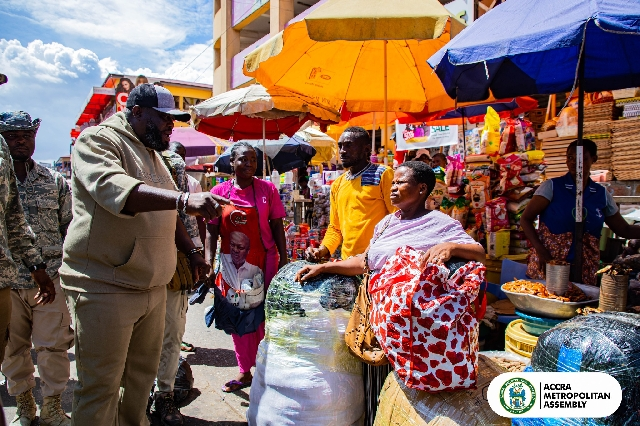
The Accra Metropolitan Authority’s ongoing skirmish with market women is a farce, a masterclass in weakness masquerading as governance. These women, adept at weaponizing tales of hardship—poverty, widowhood, single motherhood—hold the city hostage, threatening to swing votes to the opposition unless the government abdicates its duty. The government, predictably, capitulates, allowing blatant lawbreaking: illegal vending on walkways, obstruction of traffic, and the complete disregard of road safety laws.
My own observations, informed by years of studying post-independence Accra, only sharpen the sense of loss. Accra once stood as a paragon among African capitals. Its roads, buildings, and public spaces exuded dignity and order. Today, that legacy is in ruins, replaced by a cityscape of chaos: “containerized” markets, lawless streets, and a public sector riddled with corruption and incompetence. The narrative is as clear as it is damning—spineless, transactional leadership and a population conditioned to whine and threaten rather than participate constructively. In Accra, policies have become foreign concepts, and public officials—most of whom are corrupt and inept—have abdicated their responsibilities. The city has devolved into a zoo, a patchwork of market ghettos, its former elegance sacrificed on the altar of political expediency and systemic failure.
While I do not oppose the right of market women to seek a livelihood, the spectacle of lawbreaking under the guise of necessity is, frankly, indefensible—and the expectation that the government should provide markets on demand borders on the absurd. In a 21st-century neoliberal context, it is not, nor should it be, the government’s mandate to seize or purchase land to accommodate every vendor’s commercial ambitions. To entertain such a juvenile proposition is to suggest, by extension, that the state should be personally responsible for feeding every child on the speculative basis that they might one day contribute to the national workforce—an argument both logically and economically bankrupt.
For decades, since 1992, Ghana’s political parties have engaged in a futile arms race of hollow promises, each outbidding the other with fantastical pledges that ultimately translate into chaos: unregulated street vending, mountains of garbage, and an urban environment in constant disarray. The market women, for their part, have become virtuosos of victimhood—recycling tales of abandonment, poverty, and hardship as a calculated strategy to extort perpetual government intervention. These narratives, suspiciously uniform despite disparate circumstances, are nothing more than well-rehearsed scripts designed to wring endless concessions from the state. The implicit demand—that the nation’s treasury be emptied to underwrite their personal struggles—is not only unsustainable, but patently ludicrous, a burden that even the world’s wealthiest nations, such as the United States, would not entertain. To capitulate to these demands is to invite fiscal ruin and institutionalize dependency at the expense of national progress.
One of the most glaring manifestations of administrative insanity—a testament to the utter bankruptcy of leadership in Ghanaian politics and governance—is the GHC 1,000 payment scheme handed out to market women, all in the name of enforcing an arbitrary red line conjured up by the Accra Metropolitan Authority. This is not policy; it is pandemonium masquerading as governance. I challenge these reactionary, short-sighted authorities: by what legal, regulatory, or policy precedent do you justify bribing individuals who have brazenly flouted the law, who have demonstrated nothing but contempt for civic order? Where, precisely, is this money coming from—and at whose expense?
It is a grotesque parody of public policy to reward lawbreakers under the pretense of compliance, while turning a blind eye to the relentless erosion of civic standards. Such a makeshift, ill-conceived policy does not solve the problem; it amplifies it, drawing in market women from every direction, all eager to gorge themselves at the golden trough Accra’s authorities have so fecklessly set out. In doing so, the city not only institutionalizes lawlessness but actively incentivizes it, eroding any vestige of respect for public order and sound governance. This is not leadership; it is abdication, plain and simple, and the consequences will reverberate far beyond the city’s already chaotic streets.
The Ghanaian predicament is as entrenched as it is infuriating, and the saga of the market women is simply a glaring facet of a deeper, national malaise. Decades of policy vacuum have bred nothing but helplessness and a corrosive sense of entitlement. The prevailing Ghanaian mindset—exemplified by the market women—is that personal adversity is always the fault of others, a burden to be offloaded onto the state or external actors. This pathological dependence has obliterated even the faintest spark of human agency, rendering the average Ghanaian—regardless of age—childlike, paralyzed by learned helplessness. Critical thought is a casualty; self-preservation, at any cost and by any means, is the new creed, even if it sacrifices the collective good.
With such a citizenry propped up by clueless, self-serving politicians, any expectation of a lasting, visionary solution is sheer fantasy. What passes for policy is invariably an ad hoc, cosmetic fix—a hollow gesture that dissolves under the slightest scrutiny. The NDC government, in particular, has mastered the art of empty rhetoric, saturating the airwaves with grandiloquent speeches while utterly failing to enact real, transformative change. The once-proud streets of Accra—once a model for the continent—now wallow in neglect and decay, a physical testament to national decline.
Today, Ghana is a nation of perennial complainers, professional beggars, and masters of the sob story. The culture of victimhood has become a national identity, and the capacity for self-determination has withered on the vine. Abahambe! Cry, the beloved nation—for what you were, and for what you have allowed yourselves to become.
